By Katjusa Cisar, THE BADGER PROJECT
Illinois and Michigan again raked in hundreds of millions of dollars in tax revenue on recreational weed sales last year, and Minnesota is planning to join the party by fully legalizing the drug.
Meanwhile, Wisconsin sits on a near-island of cannabis prohibition, surrounded by states with legal weed. But, as medical marijuana inches toward legalization in the state, experts say policymakers would have the benefit of hindsight from the states who went first.
Wisconsin’s neighboring states are touting the tax benefits of their legal cannabis industries, with a large share of those dollars likely brought in by Wisconsinites crossing the border to buy legally. Critics are wary of the drawbacks, but good data is lacking.
Michigan brought in about $325 million in tax revenue from medical and recreational sales in 2022, through a 10% excise tax and a 6% sales tax, according to the state’s Cannabis Regulatory Agency. That’s about a 30% increase over 2021’s tax revenue.
In February, the Michigan Department of Treasury announced distribution of about $60 million to municipalities and counties from recreational tax revenue collected during the Oct. 2021-Sept. 2022 fiscal year. The fund also gave about $70 million to both K-12 education and the Michigan Transportation Fund.
These distributions from Michigan’s marijuana regulation fund are up more than 40% from the prior fiscal year, when the treasury handed out about $42 million to municipalities and counties and a combined $99 million to K-12 education and transportation.
Michigan does not track purchases by non-residents, but some border dispensaries report about half their sales are to out-of-staters, according to the Pew Charitable Trust.

Illinois does track sales to out-of-state residents. Nearly a third of Illinois’ $1.6 billion in recreational cannabis sales in 2022 were to residents of other states, according to the state’s Department of Financial and Professional Regulation.
In July 2022, the end of Illinois’ most recent fiscal year, Gov. J.B. Pritzker boasted a record-breaking $445 million in state tax revenue from recreational cannabis sales, a 50% increase over the previous year. That’s in addition to over $146 million in local tax revenue. In a press release, Pritzker said it “translates into significant tax revenue with a portion of every dollar spent being reinvested in communities that have suffered for decades.”
Minnesota, which legalized medical marijuana in 2014, is prepping to legalize recreational sales later this year.
All three states are now fully controlled by Democrats, though Michigan legalized weed through a ballot measure approved directly by voters.
In Iowa, like Wisconsin, you can buy products containing CBD, an active ingredient in marijuana that does not cause a high, but cannabis remains illegal. Both states are controlled partially or fully by Republicans.

Jana Hrdinova, administrative director of the Moritz College of Law’s Drug Enforcement and Policy Center at Ohio State University
Over two-thirds of Wisconsinites support marijuana legalization, according to an August 2022 Marquette Law School poll. That’s a wider margin of support than Michigan voters gave the ballot initiatives that legalized medical marijuana in 2008 and recreational marijuana in 2018.
Bills from Democrats to legalize recreational use of the plant in Wisconsin have been ignored by the Republican-controlled legislature, and efforts by some Republicans to legalize the drug for medicinal purposes have met intraparty opposition. Consensus is “not that close” on the medical-use legalization, at least in the current legislative session, said Assembly Speaker Robin Vos, R-Rochester.
Vos supports limited medical-use legalization but told WISN-TV in January his support “has nothing to do with generating taxes for the state” or “creating a new industry." Instead, he said, “it should be all about helping people who through no fault of their own have a chronic disease that is awful to deal with.”
In the process of writing its budget for the next two years, Wisconsin currently has a historic, $7 billion surplus.
Critics worry about the health and crime risks of legalized public access to cannabis, the potential for more impaired driving and the effect on youth. But evidence is limited. Because marijuana remains illegal at the federal level, research restrictions on the drug prevent physicians and scientists from fully studying health risks and benefits, according to the Association of American Medical Colleges.
In the meantime, Wisconsinites can take their business out of state and bring the drug home. Recent research from the nonpartisan Wisconsin Policy Forum found that 50% of Wisconsin residents of legal age live within a 75-minute drive of a recreational dispensary.
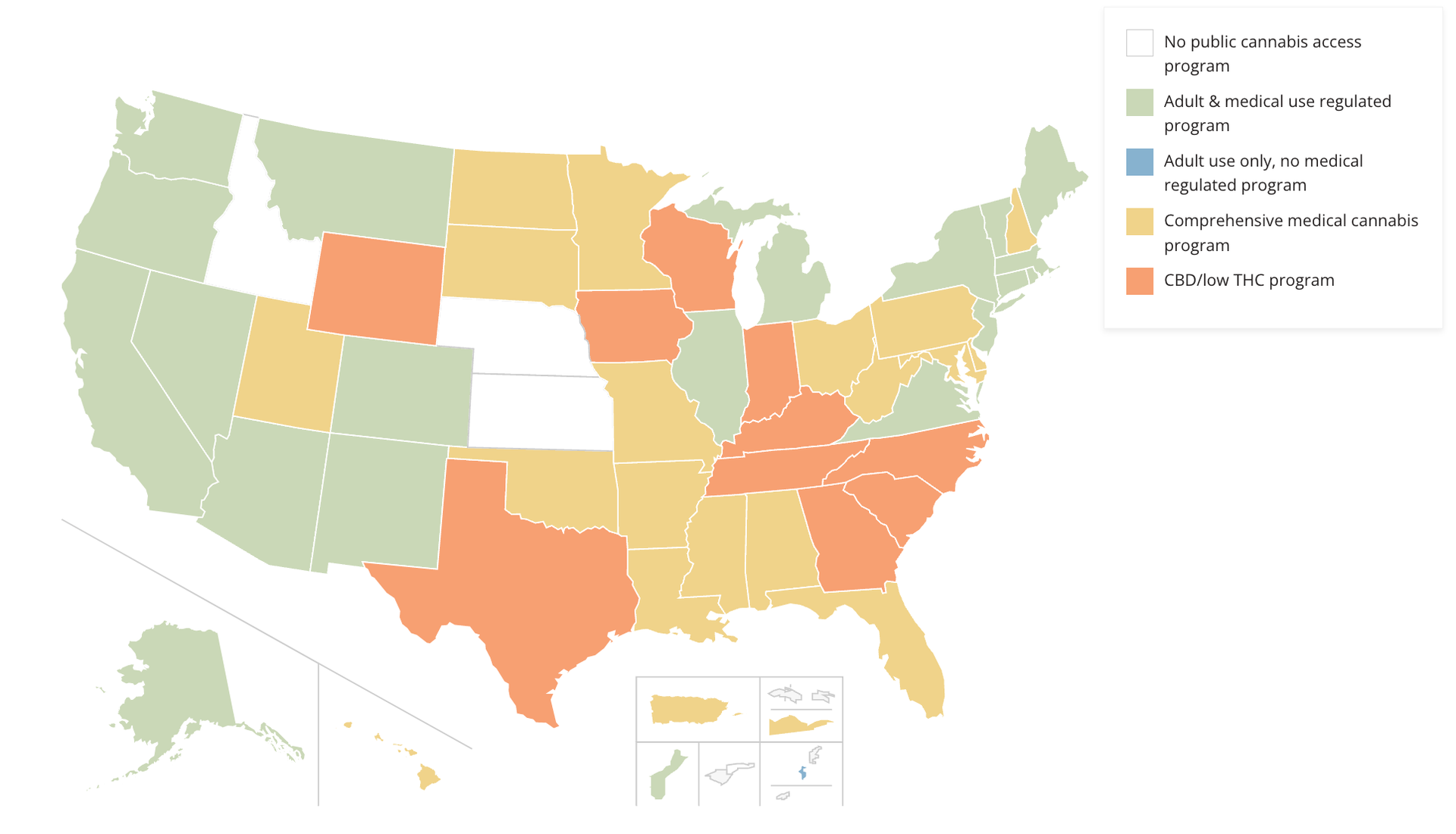
So far, 37 states have legalized medical marijuana and 21 states have legalized it for recreational use.
“There are now so many states that have gone before (Wisconsin),” said Jana Hrdinova, administrative director of the Moritz College of Law’s Drug Enforcement and Policy Center at Ohio State University. She co-authored a 2020 analysis offering “Lessons for States in Transition” from medical to recreational marijuana.
Hrdinova calls medical legalization a “stepping stone” for states.
“It seems your legislature is more inclined to go for medical, so that would be a pretty normal progression,” she said of Wisconsin.
Though recreational sales provide more tax revenue, it still amounts to a fraction of a state’s overall tax revenue. Colorado and Nevada have the highest share of state tax revenue from cannabis taxes, at 1.7%, according to the Urban-Brookings Tax Policy Center.
But, “if you design where it goes well, it can have a big impact on those programs,” said Hrdinova.
Wisconsin is no stranger to “sin taxes,” as the state already applies them to purchases of alcohol and tobacco. For fiscal year 2021, these taxes generated about $678 million, or 3.5%, of Wisconsin’s $19 billion general-purpose revenue, according to the state Department of Revenue. Almost 90 percent of it came from cigarettes, vaping and other tobacco products.
Early adopters of cannabis legalization focused on sending tax revenue to public health initiatives like treating substance abuse. In recent years, there’s been a shift toward social justice goals as well.
“In the last five years, we have seen a much more robust discussion about the past harms of the war on drugs. The people who have been disproportionately punished are now disproportionately not benefitting from the industry,” Hrdinova said, adding that Illinois is a leader in addressing this inequity.
The Illinois recreational Cannabis Social Equity Program aims to encourage industry participation among people with expungable, cannabis-related criminal records.
The legal market for cannabis is still very new and of course doesn’t represent all sales or consumption. The majority of Michiganders, for example, still get the drug untaxed on the illicit market or grow it themselves, according to a 2021 economic analysis commissioned by the Michigan Cannabis Manufacturers Association.
Legal allowances for growing weed at home for personal use, which some states grant, don’t bring in tax revenue but are “very popular with voters,” said Hrdinova.
The Badger Project is a nonpartisan, citizen-supported journalism nonprofit in Wisconsin.
This article first appeared on The Badger Project and is republished here under a Creative Commons license.