Frank Lloyd Wright may be the most famous architect who ever lived. He called Madison home and his influence and artistic eye has made an impact throughout the city, from our most iconic buildings to hidden gems in residential neighborhoods.
On the City Cast Madison podcast today, host Bianca Martin talks to March Sweitzer about Wright’s Unitarian Meeting House, which is celebrating its 75th anniversary this year with an array of events starting this week.
Here’s your guide to some of his architectural feats in and around Madison, from iconic public buildings to private homes.
Wright transformed downtown Madison with his vision for Monona Terrace, with panoramic views of Lake Monona and a terrace that leads directly to the Capitol Square. He drafted the plans in 1938, but wasn’t finished until 1997, nearly 40 years after his death. Check out “Inspired by Wright,” a fourth-floor exhibit detailing Wright’s vision for Monona Terrace and for Madison.
One of our favorite buildings in Madison is this gorgeous structure Wright built for his congregation in 1946, whose triangular design is meant to evoke both a farm plow and a pair of praying hands.
Any Wright fans will plan a trip out to the Driftless Region to see Wright’s home and studio on a beautiful 800-acre piece of land near Spring Green.
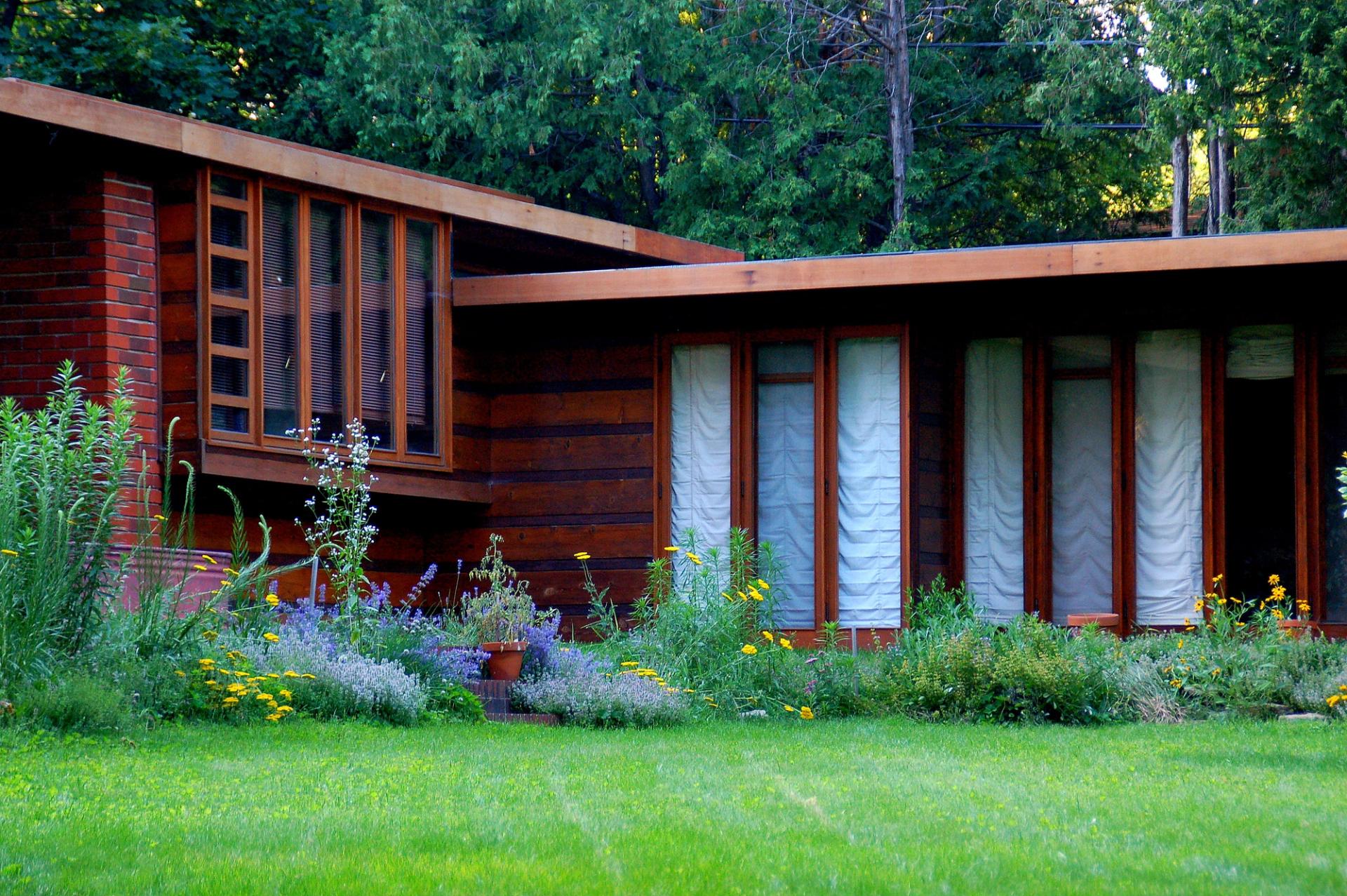
The Herbert Jacobs House was Frank Lloyd Wright's first attempt at creating what he called a "Usonian" home. (Keith Ewing / Flickr)
One of Wright’s visions was to build affordable housing that had an uniquely American aesthetic. His first attempt (made for just $5,000) at “Usonian” (United States of North America) architecture was at 441 Toepfer St. for Herbert Jacobs, featuring natural materials in harmony with the environment and an open-plan interior. Wright would go on to build 140 “Usonian” homes, and his designs influenced ranch home architecture of the ‘50s and ‘60s.
Wright won a competition in 1893, when he was only 26, to design this boathouse, featuring two towers connected by an arch. He also designed a boathouse for Lake Monona that was never built, but in recent years there’s been a groundswell of interest in finally building it.
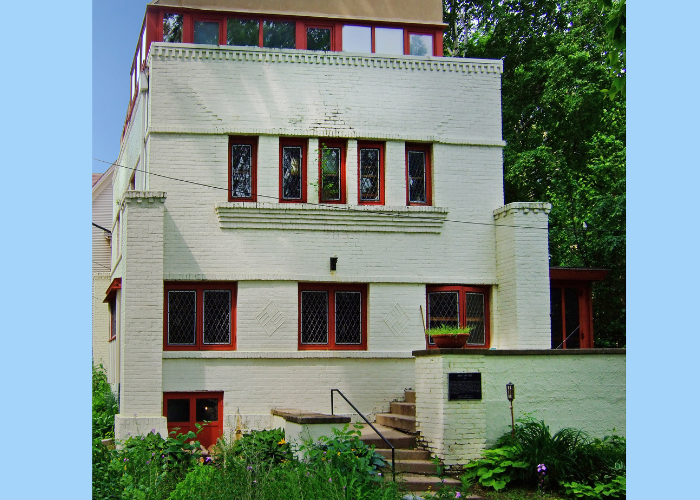
The Robert Lamp House on Butler Street was once known as the Rocky Roost. (James Steakley / Wikimedia Commons)
This 1903 residence at 22 N. Butler Street was once known as the Rocky Roost, and features an asymmetrical design and a third story roof garden. Its mix of styles lead some to speculate that one of Wright’s employees, Walter Burley Griffin, actually oversaw the design while Wright was immersed in other projects.
In contrast to Wright’s sprawling Prairie homes, this private residence near Camp Randall sits on a hill and is a two-story monolith. Because it’s built across two axes converging on a central fireplace, it’s earned the nickname “The Airplane House.”
It can be hard to find this modest private home at 3650 Lake Mendota Drive, nestled on the shore of Lake Mendota in the Shorewood Hills neighborhood. The design and natural materials blend in perfectly with its natural surroundings, and features floor-to-ceiling windows looking out over the lake.
Wright’s passion for affordable Usonian housing for the middle class led to his interest in “prefab” housing packages. This one at 110 Marinette Place was built for a pair of married UW-Madison mathematicians.