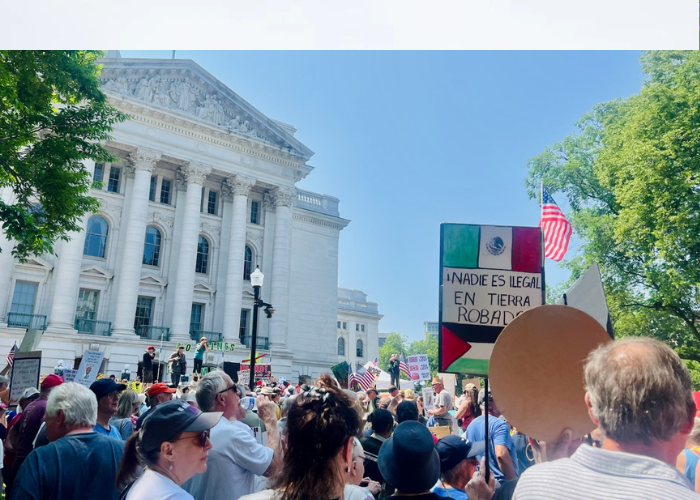
Last weekend, an estimated 6 million people (including an estimated 15,000 in Madison) came out to protest peacefully as part of the nationwide “No Kings” rallies opposing the policies of President Donald J. Trump’s administration.
On the City Cast Madison podcast today, executive producer Hayley Sperling talks with Ryan Cox, legal director of the American Civil Liberties Union-Wisconsin, about the do’s and don’ts of protesting peacefully.
Here are a few more tips courtesy of the ACLU and Human Rights Campaign.
How To Prepare Ahead of Time
Research the area where the protest will be taking place, print out a map of where you'll be, and familiarize yourself with the available exit routes. Arrange backup travel plans in case you can’t easily get back to your vehicle or public transportation route. If you are going with friends, make plans ahead of time on where and when to reconnect if separated.
Bring water, cash, and any medications you need. Dress for the weather and wear protective clothing like long sleeves, as well as earplugs, shatterproof goggles, and/or a face mask.
Bring a phone charger or battery extender. Memorize the phone numbers of your lawyer and family members in case you get detained (don’t rely on your phone).
What To Do at the Protest
Stay aware of the environment around you. If you see something suspicious (someone acting strangely, unclaimed packages, suspicious vehicle, etc.) notify law enforcement or any protest organizers on site.
The ACLU says your rights are strongest in “traditional public forums” such as streets, sidewalks, and public parks, rather than on private property. Other public spaces, such as plazas in front of government buildings, are safe, as long as you are not blocking access to the building or interfering with its function.
Private property owners can voluntarily allow free speech on their property, and the government cannot restrict that speech if you have the property owner’s consent.
If you are lawfully present in a public space, you have the right to photograph anything in public view. As with speech, private property owners have the right to set rules for photos and video taken on their property.
You don’t need a permit to march on streets or sidewalks as long as you are not obstructing vehicles or foot traffic. If you don’t have a permit, though, police can ask you to move aside to let people or cars pass or for safety reasons.
If you find that the situation is escalating, stay calm, avoid provocative behavior, and, if necessary, remove yourself from the situation.
What To Do If Your Rights Have Been Violated
Write down everything you remember. Get contact information for witnesses. Take photographs of injuries. If police are involved, get the officers’ badge and patrol car numbers and the agency they work for. Once you have this information, you may file a complaint with the agency’s internal affairs division or, in Madison, the Independent Police Monitor and Civilian Oversight Board.
If detained by law enforcement, do not resist or escalate the situation. State your right to remain silent and that you want a lawyer.