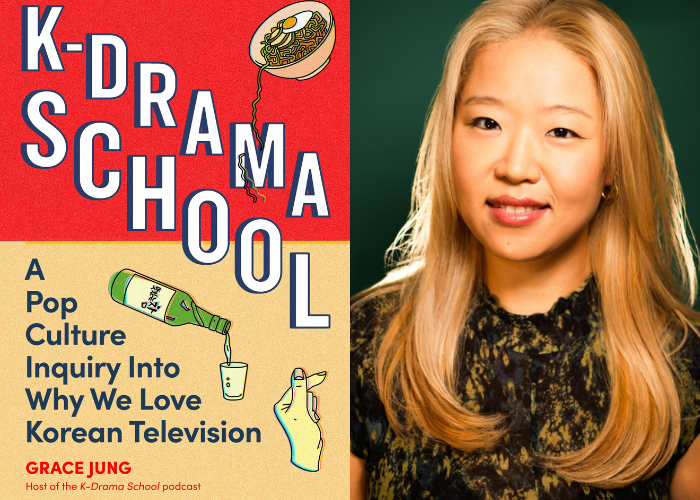
Many might assume that a cold Wisconsin winter is a time for people to hunker down inside and binge-watch television, such as “Squid Game” or the other Korean television shows that have taken the world by storm.
But, in a plot twist worthy of the Korean dramas that she writes and podcasts about, UW-Madison visiting professor Grace Jung said she’s spent a lot of time outside since she moved to Madison from Los Angeles last September. During an interview about her new book, “K-Drama School,” Jung was recovering a pulled muscle in her back from going cross-country skiing earlier in the day.
“I like Wisconsin,” she said. “There’s actually a lot to do here. I’ve been more physically active for sure.” She’s also become a fan of Madison’s bakeries, and bought herself some peanut butter pie at the Willy Street Co-op earlier in the day.
At 7 p.m. Wednesday at the Madison Central Library, Jung will talk about “K-Drama School.” Having grown out of her podcast of the same name, the book is part chatty recap, part cultural exploration of what drives and inspires Korean dramas. A chapter on the popularity of amnesia storylines, for example, dives into the collective amnesia of South Korea of its time living under Japan’s colonial rule.
Where is there overlap for you between teaching at UW-Madison and being a podcaster, a writer, and a stand-up comedian?
For me, teaching is more or less just holding people’s attention for however long I have to be up there. All the things I did, the main idea is to not bore the audience and hold their attention. I think given my background in show business and other work, it makes teaching a lot easier for me. The work is me thinking what brainy things I can offer them, and how can I make sure they’re with me?
What was the process like of turning your podcast into a book?
I’d been covering a whole show for every single episode. And I was looking for patterns, like what would be interesting to discuss? What kind of questions did I have when I was younger and watching these kinds of shows, wondering why the same few things keep happening on these shows. So I just decided to answer these questions myself.
The sub-headline to your book is “A Pop Culture Exploration of Why We Love Korean Television.” Who’s “we”?
It’s not a big secret these days that people globally appreciate and watch Korean television shows. That’s visible, considering how all the Hollywood conglomerates are also invested in Korean television shows. The “we” speaks to fans of those shows. It also can be curious audiences who find themselves surprised by watching a TV show that doesn’t reflect their ethnic or cultural background. Even with the language barrier, it’s like, “I can’t stop watching these shows.”
How has doing this deep-dive into Korean television changed your appreciation of them?
Whatever there was to explore, I feel like I’ve explored them to my heart’s content. Nowadays, I don’t really binge-watch K dramas like I used to. That’s also been a big reason why I pulled back from the podcast. So I’m cooking up ways of how to do Season 2.
Both your podcast and your book are very personal at times, so I imagine whatever you do next will reflect that evolution in who you are.
In the last six months, I’m definitely not the same person anymore. My interests have become much more diverse from the kinds of things I used to put my time and effort into. I have to be sedentary and read and write for my job now. Whenever I have time away from doing that, I like to be outside and go cross-country skiing. Even if I throw my back out.
Wisconsin has just been a fun place for me to explore things more physically and out in nature. I’m just watching things evolve and change and going like, “Oh, that’s interesting. Let’s see what comes next.”