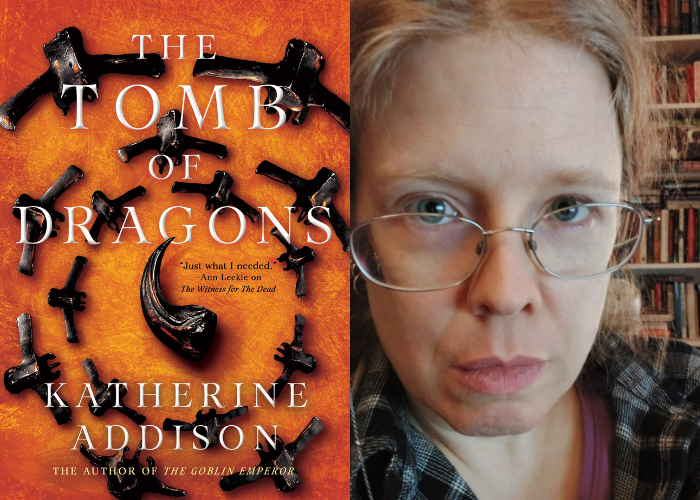
It’s a good time to be a fantasy writer, but Katherine Addison was writing fantasy stories before the likes of Rebecca Yarros and Sarah J. Maas were dominating the best-seller charts. Addison (the nom de plume of Madison author Sarah Monette) has written a number of acclaimed fantasy novels, including the new “The Tomb of Dragons,” which caps her “Cemeteries of Amalo” trilogy featuring Thara Celahar, a mystery-solving elven medium.
“I have never written a successful realistic story,” Addison said in a recent email interview. “There has to be a dragon. Or a ghost. Or, you know, a ghost dragon.”
“The Tomb of Dragons” was published March 11, and Addison will read from and talk about the book at 6 p.m. March 13 at A Room of One’s Own. Addison talked about the challenges of writing a trilogy, what it’s like to be in the middle of fantasy novel boom times, and how Wisconsin inspires her fantasy worlds.
The last time I interviewed you for the Capital Times in 2019, you were in the middle of writing what would become the first novel in a trilogy. What inspired you to make that the start of a trilogy? How do you feel now looking back on the three books?
I was about two-thirds of the way through “The Witness for the Dead” when I realized the story I wanted to tell was actually much longer, that I hadn't traveled nearly far enough with Thara Celehar. I will not say that the next two books (“The Grief of Stones” and “The Tomb of Dragons”) unspooled themselves then and there, but I had a sense of the links in the chain of the story and a very general sense of where we were going to end up.
Now, looking at the trilogy, I'm mostly just relieved that we — Celehar and I — pulled it off. Writing a series is terrifying, because every decision you make closes off another avenue of escape, and you commit yourself to more and more baggage. Eventually you end up painted into a corner and you just have to hope that your plans come out right and it's the corner with a window.
How did you balance making sure each book stood on its own while making them work together as a trilogy? What did you try to do differently with each book, especially Tomb of Dragons?
Since each book is a mystery (okay, “The Tomb of Dragons” less so, although it has mysteries IN it), it was actually relatively easy to make each tell its own story. That is one of the great things about the mystery genre, for a writer: it gives you a plot outline as part of the package. And the larger story, Celehar's arc from bleak depression to cautious hope, had certain things that each book needed to accomplish, and those things created ties from book to book.
In a volatile time for publishing, the one unabashed success story has been fantasy. How has that affected you as a fantasy writer?
I have always loved fantasy, from the time I was a very small child. Obviously I got lucky, because it was never that I looked at what was selling and said, "I'll write that!" It was that the way my brain is wired, the stories it tells are always fantastical in one way or another. I have never written a successful realistic story. There has to be a dragon. Or a ghost. Or, you know, a ghost dragon.
Do any elements of Madison or Wisconsin make their way into the fantasy worlds you create?
I grew up in Tennessee, and it wasn't that we didn't have winter, but we didn't have capital-W Winter the way Wisconsin does. So winter in Amalo is definitely Madison winter.
What are you working on now?
I'm currently taking a little bit of a vacation. The Cemeteries of Amalo were very difficult for me to write, technically speaking, because I can never learn to choose the murderer BEFORE I write the investigation of the murder, so I finished “The Tomb of Dragons” exhausted and pretty burnt out. Tor has promised me that the next book can be anything I want — which is fantastic, but it also means a little bit of decision paralysis. There are so many things I could write! How can I possibly choose just one?