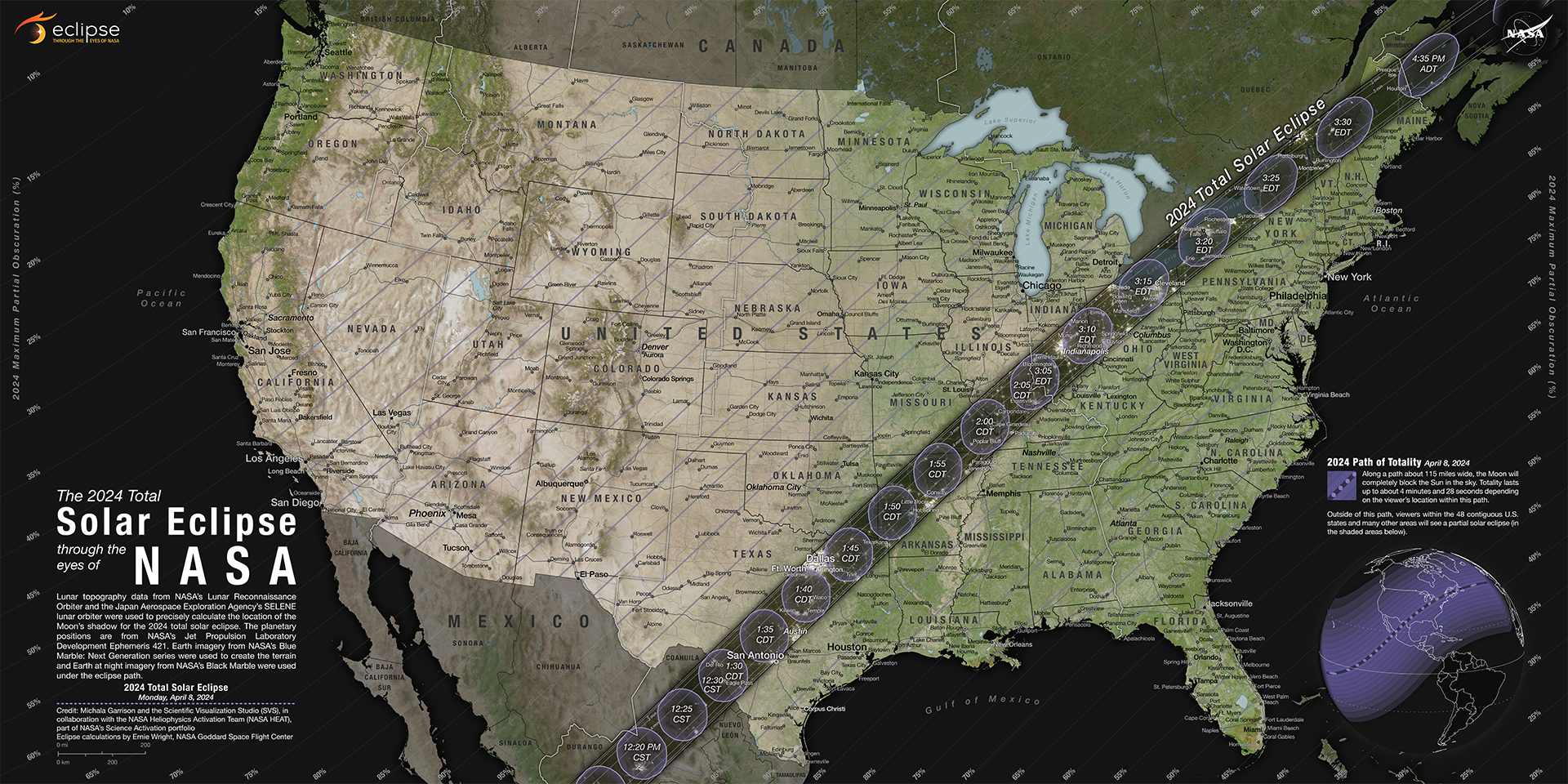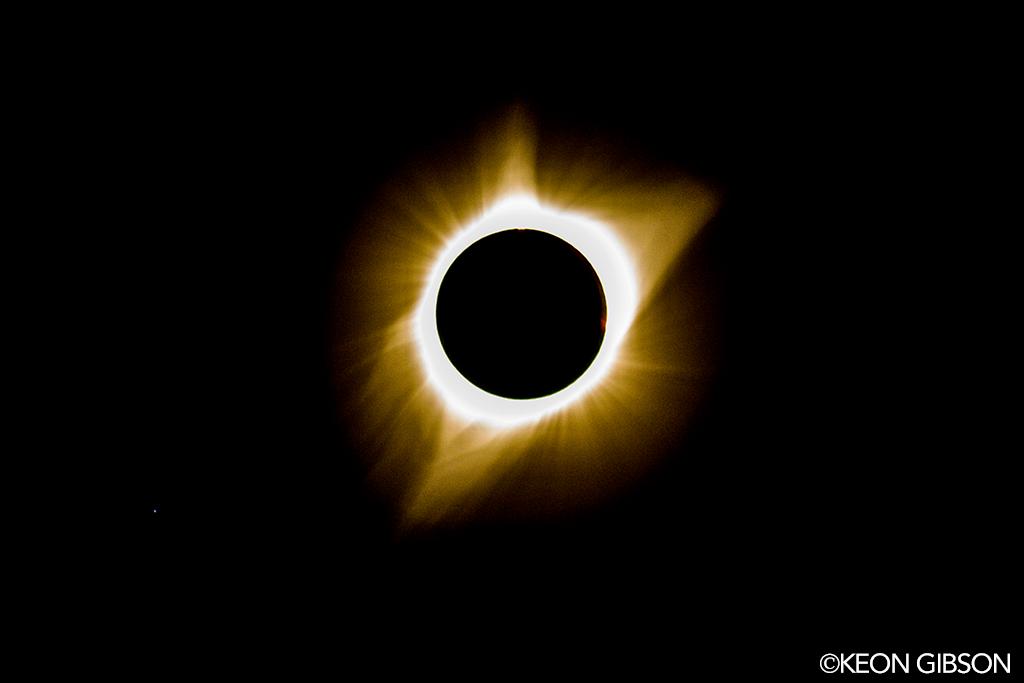
On Monday, April 8, a wide swath of North America will plunge into darkness for a few minutes in mid-afternoon. A solar eclipse will occur when the moon passes between the sun and Earth, blocking out our precious sunlight for a few rare minutes. The next full solar eclipse won’t occur until 2044, in another 20 years.
More than 30 million people live in the “path of totality,” meaning they’ve got a front-row seat to the astronomical event. Wisconsin is sadly not in the path, so we’ll only see a partial eclipse around 2 p.m. But get in, it’s not too late to plan a road trip.
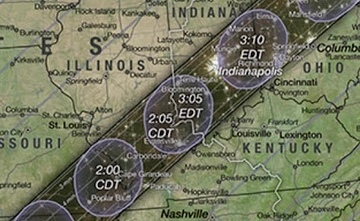
Illinois and Indiana are in the solar eclipse’s path of totality on April 8, 2024. (NASA)
Where to Watch
Several universities in Illinois and Indiana are going all-in on eclipse festivities.
- Indianapolis, a five-hour drive from Madison, is offering a free event with telescopes at Butler University’s Holcomb Observatory.
- Bloomington, Indiana, is throwing a “Hoosier Cosmic Celebration,” and bringing some star power to their watch party, including performer Janelle Monae, William Shatner of “Star Trek” fame, and Mae Jemison, America's first woman of color to travel to space.
- Carbondale, Illinois, about six-and-a-half hours from Madison, will be in the center of the totality, meaning they have one of the longest eclipse viewing times. They’ve canceled classes at SIU and are tailgating in the Saluki Stadium as part of a four-day total solar eclipse festival. There’s first-come, first-serve camping available in the nearby Shawnee National Forest.
How to Watch
Do not stare at the sun with your bare eyes! There, we said it. Regular sunglasses are not strong enough, so you’ll want to snag a pair of eclipse glasses.
Warby Parker on State Street in downtown Madison is giving away free eclipse glasses in April while their supply lasts.
University Bookstore has a six-pack available for purchase.
You can also check with the Madison Public Library, which has a limited supply that they’ll put out a few days before the eclipse.